
Abstract: The 200ML Disposable Paint Cup System 1.0 represents a foundational shift in how automotive refinishing professionals, furniture manufacturers, and industrial coating specialists approach paint preparation. By integrating mixing, filtration, spraying, and storage into a single closed-loop system, it eliminates the solvent-heavy cleaning cycles associated with traditional metal or hard plastic cups. This article examines the system's five-part modular architecture, its compatibility with mainstream HVLP and LVLP spray guns, and the practical workflow advantages it delivers across multi-color operations. Readers will gain a thorough understanding of liner technology, adapter selection, filter grades, and the operational disciplines that maximize transfer efficiency while minimizing cross-contamination risks.
- What Is the 200ML Disposable Paint Cup System 1.0 and Why Does It Matter?
- How Does the Five-Part Modular Architecture Work?
- What Spray Guns and Adapters Are Compatible with the System?
- How Does the System Streamline the Paint Preparation Workflow?
- How Does the Disposable System Compare to Traditional Reusable Cups?
- Where Is the 200ML Disposable Paint Cup System 1.0 Best Applied?
- Frequently Asked Questions
What Is the 200ML Disposable Paint Cup System 1.0 and Why Does It Matter?
The 200ML Disposable Paint Cup System 1.0 is a professional-grade paint delivery accessory designed to replace conventional reusable gravity-feed cups on spray guns. Rather than cleaning a rigid cup between color changes, technicians insert a soft, collapsible liner into a reusable outer shell and discard the liner after use. This deceptively simple premise carries substantial operational consequences for any workshop that handles primers, basecoats, clearcoats, or waterborne coatings.
The system's core value proposition rests on a closed-material path: paint is mixed inside the liner, filtered through a lid-integrated mesh, and drawn into the spray gun without ever contacting a surface that requires solvent cleaning. For body shops processing dozens of vehicles per week, the cumulative time recovered from eliminating cup-washing routines can be measured in hours, not minutes. The 200ML capacity is deliberately sized for spot repairs, panel blending, and small-area refinishing—tasks where mixing a full liter of material would be wasteful and where rapid color transitions are the norm.
Beyond time recovery, the disposable architecture addresses a chronic quality-control problem: residual pigment trapped in reusable cup threads and crevices. A single overlooked speck of black basecoat can ruin a white pearl topcoat. By ensuring every spray begins with a virgin fluid path, the system reduces the probability of color contamination to near zero. This matters not only for aesthetic outcomes but also for warranty claims and rework rates, both of which carry significant indirect costs in professional refinishing environments.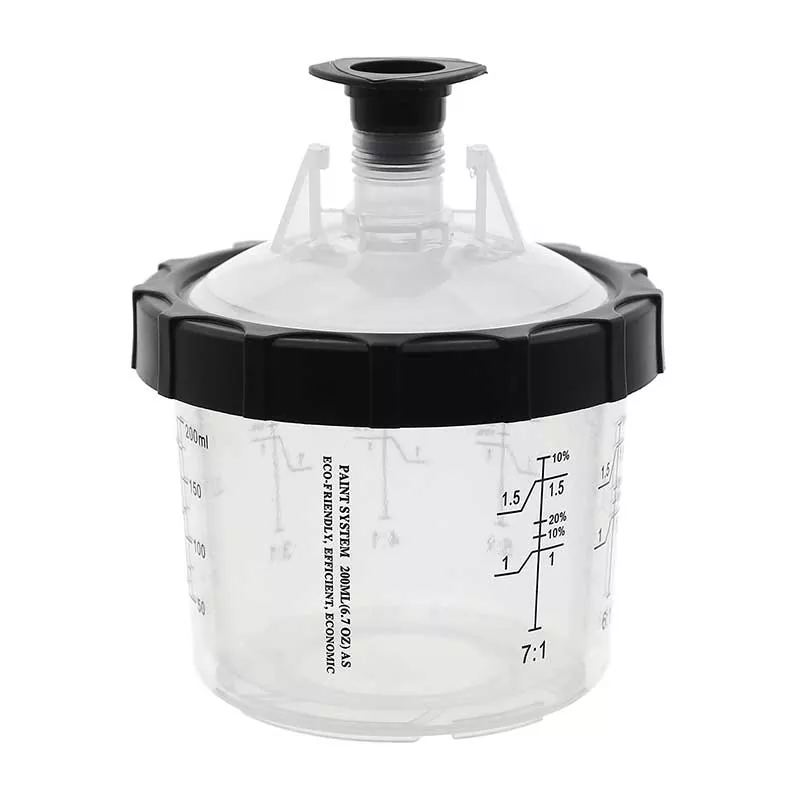
How Does the Five-Part Modular Architecture Work?
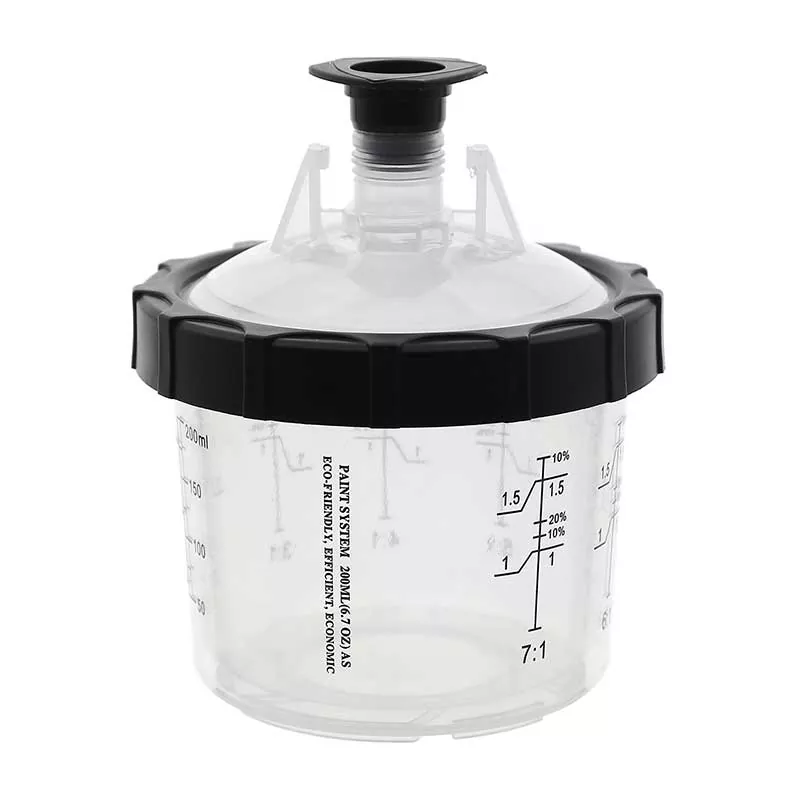
The system comprises five distinct components, each engineered for a specific role in the paint delivery chain. Understanding their interplay is essential for technicians who want to extract maximum performance from the platform.
Outer Cup
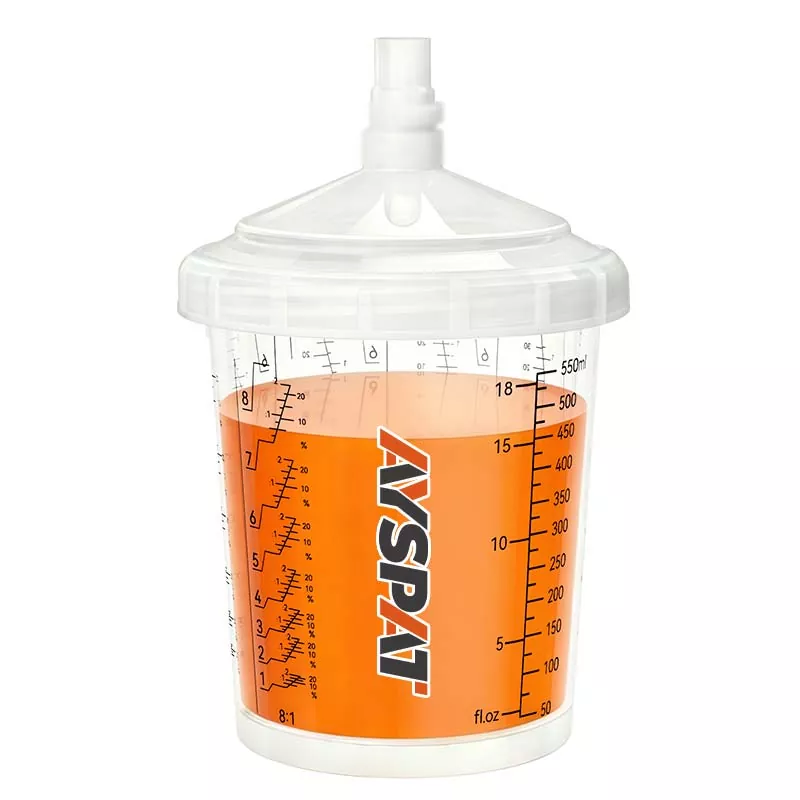
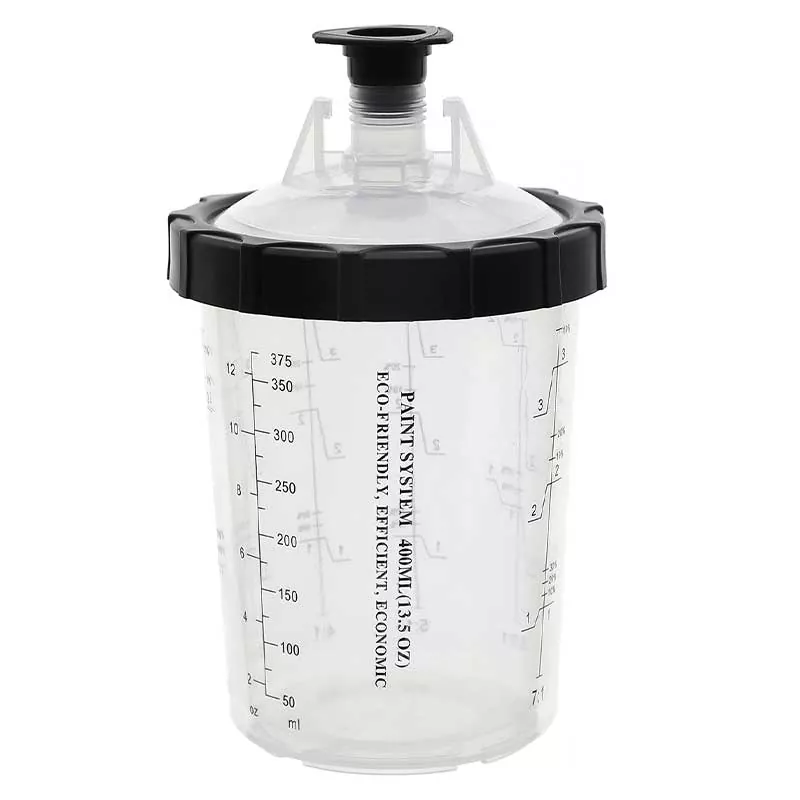
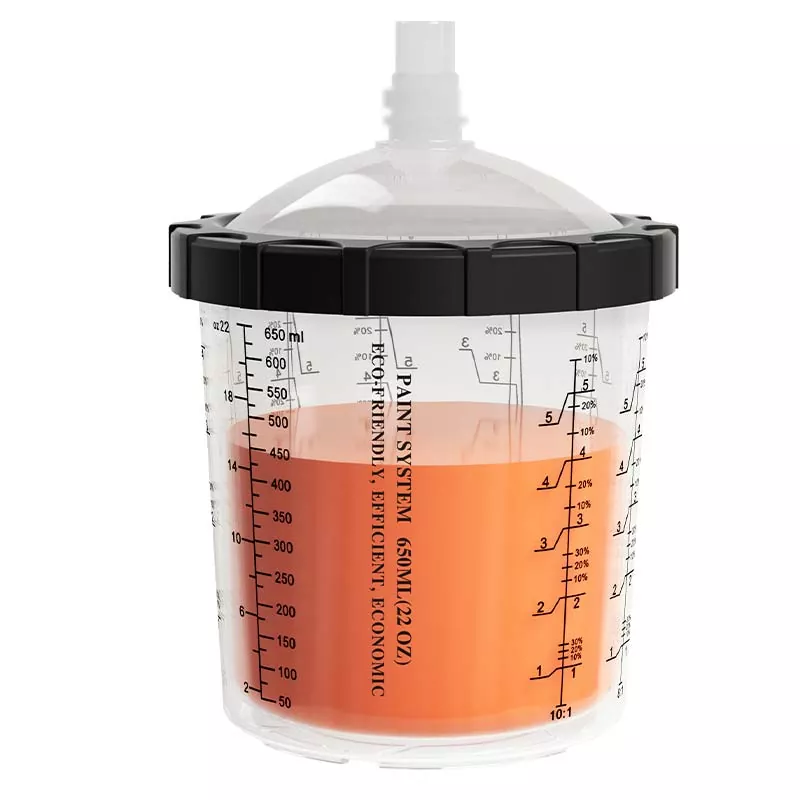
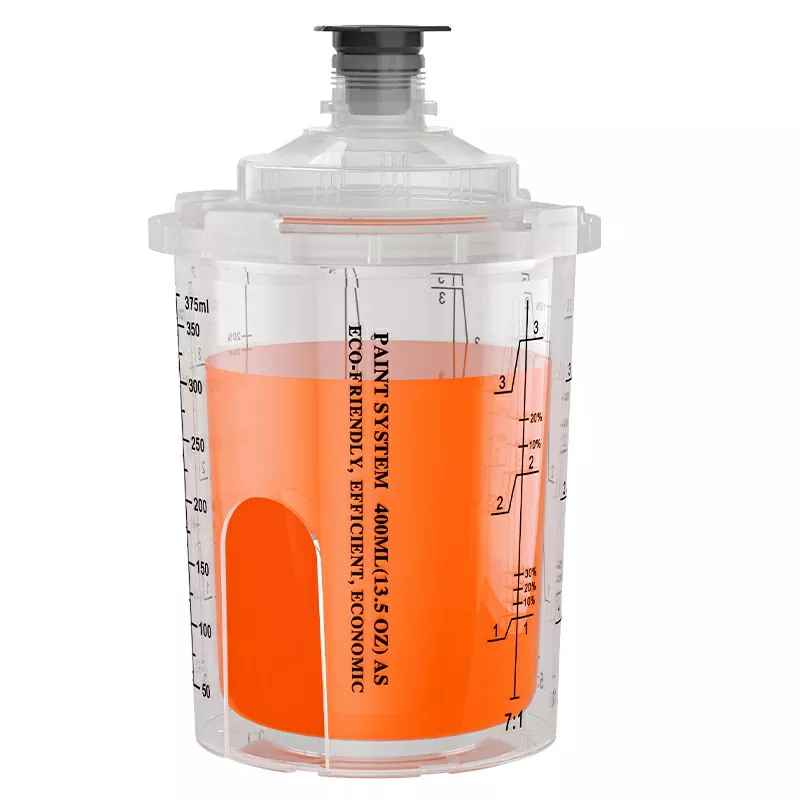
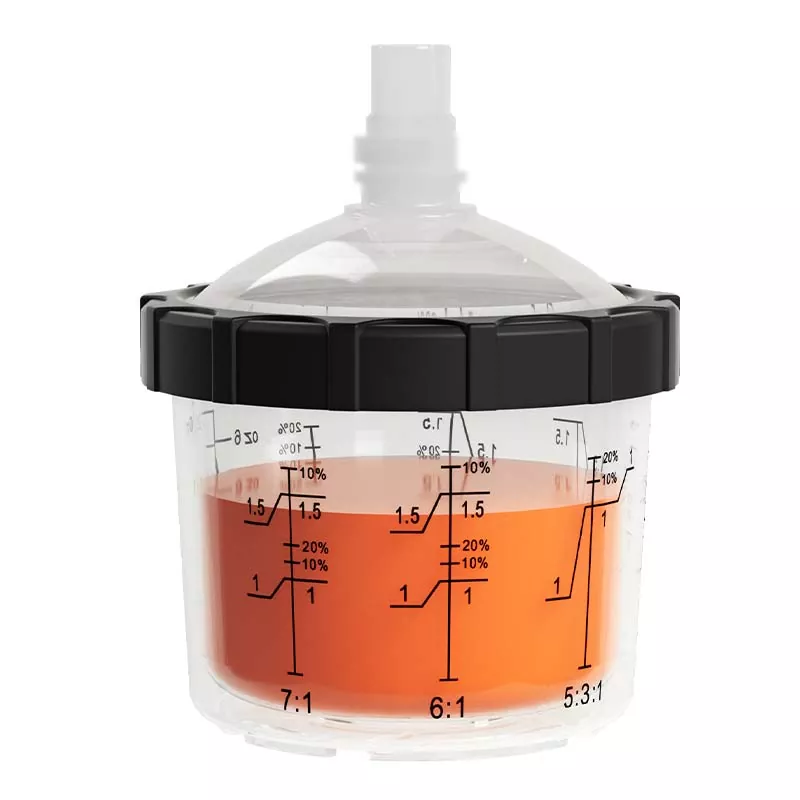
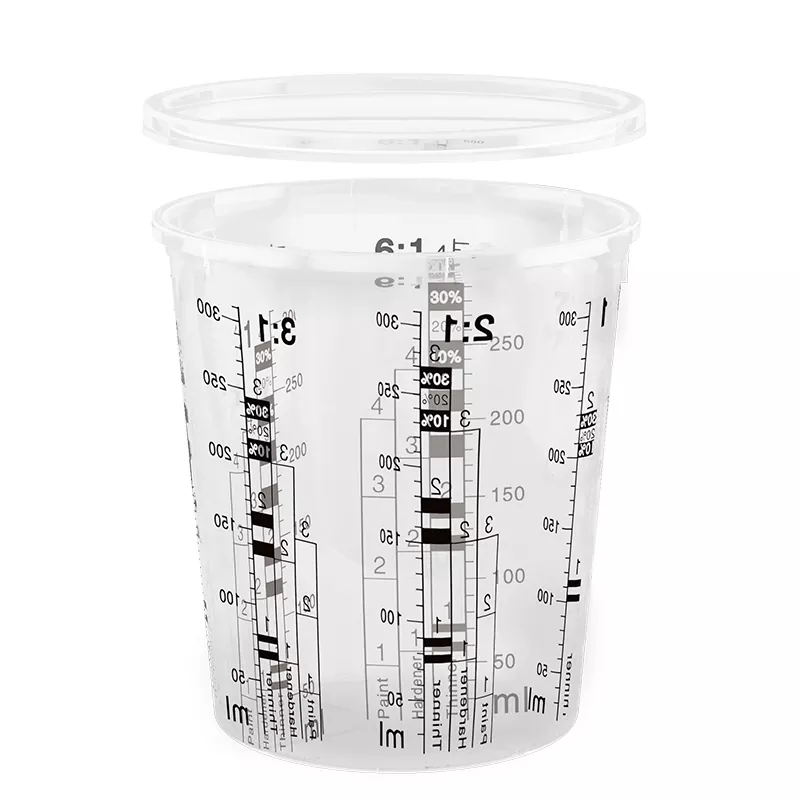
The reusable outer cup is a rigid polypropylene shell featuring printed measurement graduations and common mixing ratios. Its corona-treated surface resists paint adhesion, making occasional wipe-downs straightforward. The outer cup serves as the structural backbone that holds the flexible liner in shape during filling and mixing.
Inner Liner
The liner is the consumable heart of the system. Made from a soft, transparent LDPE film, it collapses spirally as paint is consumed, allowing the spray gun to operate at any angle—including inverted—without losing fluid pickup. This collapsible behavior also minimizes dead volume, meaning less paint remains trapped in the cup at the end of a spray session.
Cup Ring (Collar)
The locking collar secures the lid and liner assembly to the outer cup. Its single-thread engagement design reduces the risk of cross-threading, a common frustration with multi-start threads on traditional cups. The collar can be quickly released and re-engaged even when paint residue accumulates on the threads.
Cup Cover (Lid with Integrated Filter)
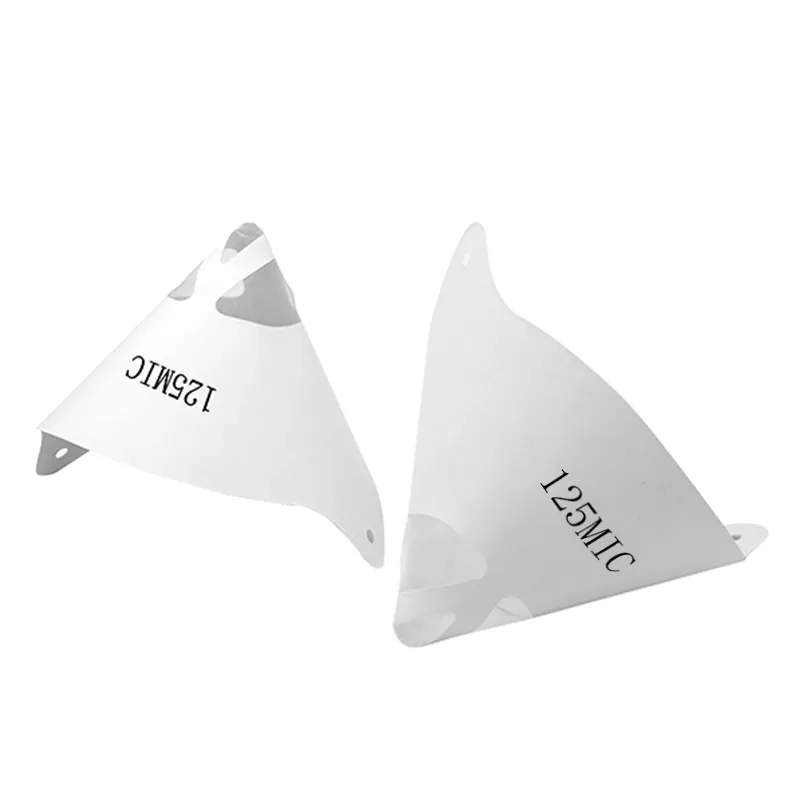
The lid houses a full-diameter mesh filter available in 125-micron or 190-micron grades. This integrated filtration step replaces the separate paper strainers that conventional workflows require, eliminating a handling step and reducing the chance of foreign particles reaching the spray gun's fluid nozzle. The filter mesh is uniform, promoting consistent material flow and even atomization.
Cup Stopper
The stopper seals the lid's vent port when the cup is detached from the gun, enabling temporary storage of unused mixed paint. A widened spout column strengthens the sealing interface and prevents leakage during transport or short-term storage.
- All five components work as a unified fluid path with no exposed threads in the paint channel.
- The liner's spiral collapse maintains consistent fluid delivery even in awkward spray orientations.
- Filter grades allow technicians to match filtration to coating type and finish requirements.
- The stopper enables legitimate short-term storage without decanting into secondary containers.
What Spray Guns and Adapters Are Compatible with the System?
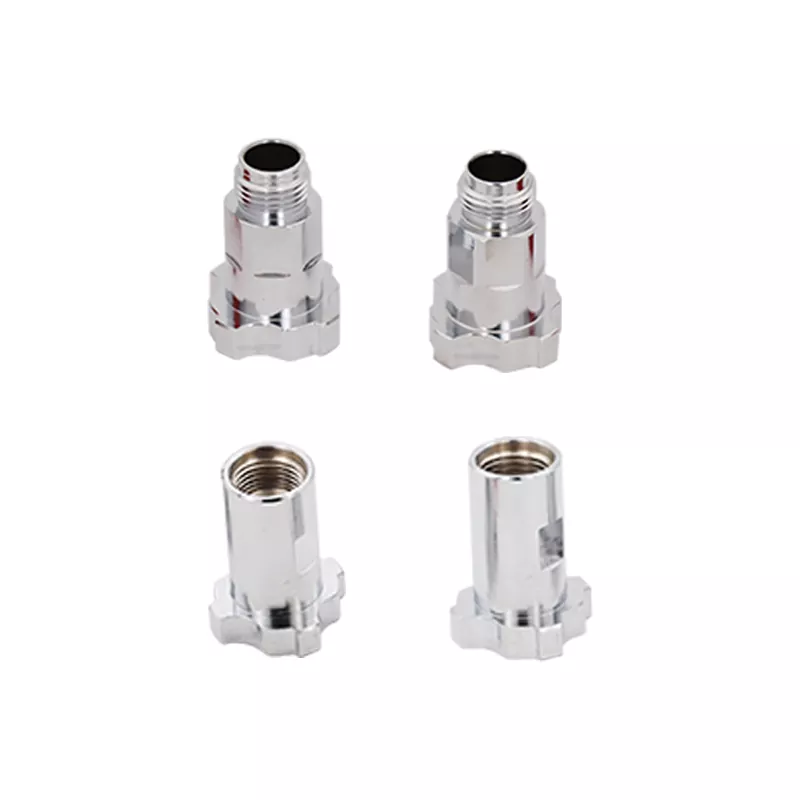
One of the most practical questions surrounding any paint cup system is whether it will fit the spray guns already in a technician's cabinet. The 200ML Disposable Paint Cup System 1.0 addresses this through a standardized adapter interface that mates with the PPS 1.0 connection profile. This means the system is compatible with a broad range of mainstream HVLP and LVLP gravity-feed spray guns, including models from established manufacturers such as DeVilbiss, SATA, and Iwata, provided the correct adapter is selected.
Adapter selection depends on the gun's fluid inlet thread specification. Common thread types include 16mm female, 16mm male, and 3/8-inch NPS variants. Technicians should verify their gun's inlet thread before ordering, as an incorrect adapter will either fail to seal or will not engage the cup collar. Once the correct adapter is installed, the cup assembly attaches with a single twisting motion—the system's "1 twist fast locking" design is intended to reduce setup time compared to multi-threaded conventional cups.
| Component | Material | Function | Reusability |
|---|---|---|---|
| Outer Cup | PP (polypropylene) | Structural shell with measurement scale | Reusable |
| Inner Liner | LDPE film | Collapsible paint container | Disposable |
| Cup Ring (Collar) | PP | Lid and liner locking mechanism | Reusable |
| Cup Cover (Lid) | PP with mesh insert | Integrated filtration and sealing | Disposable |
| Cup Stopper | LDPE | Vent port sealing for storage | Disposable |
How Does the System Streamline the Paint Preparation Workflow?
The conventional paint preparation sequence—measure, mix, strain, pour, spray, clean, repeat—contains multiple transitions where material can be lost, contaminated, or mishandled. The disposable cup system compresses several of these steps into a continuous operation within a single vessel.
Step One: Liner Insertion and Measurement
A fresh liner is placed into the outer cup. Because the liner is transparent and the outer cup features clear graduations, the technician can pour components directly into the liner and read the volume against the scale. No separate mixing cup is required for the measurement stage.
Step Two: In-Cup Mixing
Hardener, reducer, and base material are combined inside the liner. Gentle stirring with a mixing stick for one to two minutes homogenizes the mixture while minimizing air entrainment. The liner's flexibility allows the technician to swirl the contents without splashing over the rim.
Step Three: Lid Attachment and Filtration
The disposable lid, carrying its integrated mesh filter, is pressed onto the liner and secured by the collar. This step simultaneously seals the cup and positions the filter in the fluid path. The filter strains the mixture as it flows toward the spray gun, capturing agglomerated pigment or foreign particles that would otherwise appear as surface defects.
Step Four: Spraying and Collapse
As the gun is triggered, the liner collapses inward. This behavior is not merely a convenience—it is a fluid-delivery mechanism that maintains positive pressure on the remaining paint, ensuring consistent flow even when the gun is tilted. The system can spray upside down, which is particularly useful when coating undersides, rocker panels, or recessed areas.
Step Five: Disposal or Storage
When the spray session ends, the technician has two options. For immediate disposal, the liner and lid are removed and discarded, leaving only the outer cup, collar, and adapter to be wiped clean. For short-term storage, the stopper is inserted into the lid's vent, and the entire cup assembly can be set aside for later use without transferring the paint to another container.
- Reduced handling steps: Measurement, mixing, filtration, and spraying occur in one vessel.
- Consistent fluid delivery: The collapsing liner maintains flow regardless of gun orientation.
- Minimal cleaning surface: Only the outer cup and collar require attention between uses.
- Legitimate storage option: The stopper allows sealed, temporary holding of mixed material.
How Does the Disposable System Compare to Traditional Reusable Cups?
The decision to adopt a disposable cup system is fundamentally a comparison between recurring consumable costs and the recurring costs of solvent, labor, and rework associated with reusable cups. This comparison is not always intuitive, particularly for shops that have used metal or hard plastic cups for decades.
| Factor | Traditional Reusable Cup | 200ML Disposable Paint Cup System 1.0 |
|---|---|---|
| Cleaning requirement | Full solvent wash after every use | Outer cup wipe-down only |
| Color change time | Several minutes per change | Seconds—swap liner and lid |
| Contamination risk | Residual pigment in threads and crevices | Virgin fluid path every time |
| Spray orientation | Gravity-dependent; loses pickup when tilted | Any angle, including inverted |
| Paint residue in cup | Significant dead volume remains | Liner collapse minimizes waste |
| Filtration step | Separate paper strainer required | Integrated into lid |
| Storage of mixed paint | Requires transfer to separate container | Stopper seals cup for short-term storage |
| Solvent consumption | High, driven by cup washing | Dramatically reduced—gun cleaning only |
The comparison table reveals that the disposable system's advantages are concentrated in time-sensitive and quality-sensitive dimensions. A shop that performs three color changes per day across multiple vehicles will experience a compounding reduction in non-productive time. A shop that struggles with occasional contamination defects will see a direct reduction in rework. The trade-off is the consumable cost of liners and lids, which must be weighed against the solvent and labor that the disposable system displaces.
Where Is the 200ML Disposable Paint Cup System 1.0 Best Applied?
The 200ML capacity positions the system in a specific operational sweet spot. It is large enough to handle meaningful repair areas but small enough to avoid the waste associated with mixing excess material. Several application contexts align particularly well with its capabilities.
Automotive Spot and Panel Repair
Bumper scuffs, door edge chips, and fender abrasions are classic 200ML tasks. The volume covers a typical spot repair with enough margin for a second pass, but not so much that leftover paint becomes a disposal concern. The integrated 125-micron filter is appropriate for most basecoat and clearcoat formulations.
Multi-Color Production Environments
Shops that perform color blending or tinting trials benefit from the rapid changeover capability. A technician can mix a trial tint, spray a test card, discard the liner, and mix a revised formula—all within the span of a few minutes. Traditional cup cleaning would make this iterative workflow impractical.
Furniture and Cabinet Refinishing
Wood coating operations often involve smaller batch sizes and a wider variety of coating types—lacquers, varnishes, stains, and sealers. The disposable system's closed fluid path reduces the risk of cross-contamination between incompatible chemistries, and the ability to spray at any angle assists with coating intricate profiles and recessed panels.
Industrial Touch-Up and Equipment Coating
On-site industrial touch-up work frequently occurs in environments where solvent washing is inconvenient or environmentally restricted. The disposable liner model allows technicians to complete a repair without generating a solvent waste stream at the point of application. The used liner can be sealed and transported for proper disposal.
- Spot repairs and panel blending on automotive substrates.
- Rapid tint trials and color matching iterations.
- Small-batch furniture and cabinetry finishing.
- Field touch-up where solvent handling is impractical.
- Multi-coating workflows with incompatible chemistries.
Frequently Asked Questions
How does the liner collapse mechanism prevent paint starvation during spraying?
As paint is drawn from the liner, atmospheric pressure acting on the flexible LDPE film causes it to collapse inward against the remaining material. This collapse maintains a positive pressure gradient toward the gun's fluid inlet, so the pickup tube remains submerged regardless of the gun's orientation. The result is consistent fluid delivery even when spraying overhead or in awkward angles.
Can the 200ML Disposable Paint Cup System 1.0 be used with waterborne coatings?
Yes. The system's PP and LDPE materials are compatible with waterborne basecoats, and the 125-micron filter is well-suited for the particle size distribution of most waterborne pigments. Technicians should verify that their chosen adapter is compatible with the spray gun's wetted-path materials, as some older guns may have aluminum components that are not ideal for prolonged waterborne exposure.
What is the difference between 125-micron and 190-micron filter lids?
The micron rating describes the nominal pore size of the mesh filter. A 125-micron filter captures finer particles and is appropriate for basecoats, clearcoats, and other finishes where surface smoothness is critical. A 190-micron filter offers higher flow rates and is often preferred for primers, sealers, and high-viscosity materials where filtration speed matters more than absolute particle exclusion. Selecting the correct grade balances finish quality against flow performance.
How should the outer cup and collar be maintained between liner changes?
A wipe with a solvent-dampened cloth is usually sufficient to remove overspray or drips from the outer cup and collar. Because these components do not contact the paint in normal operation, they do not require immersion cleaning. Periodic inspection of the collar threads for dried paint buildup is advisable, as accumulated residue can interfere with the locking action. The outer cup's corona-treated surface resists adhesion, making cleanup straightforward.
Is the cup stopper reusable, or is it a disposable item?
The cup stopper is supplied as a disposable component, though in practice many technicians reuse it for multiple short-term storage cycles. The stopper's sealing performance depends on the integrity of its LDPE surface; once the material shows signs of deformation or hardening, it should be replaced to ensure a reliable seal. The system kit includes twenty stoppers alongside fifty liners and lids, reflecting the expectation that stoppers may be reused more frequently than liners.
How does the system handle high-viscosity materials such as polyester primers?
High-viscosity materials benefit from the 190-micron filter lid, which offers lower flow resistance than the 125-micron option. The liner's collapse mechanism also assists with viscous materials by maintaining pressure on the remaining volume, reducing the tendency for flow to stall as the cup empties. Technicians working with particularly heavy primers may find it helpful to select a larger-capacity cup from the same system family to extend spray time between refills.
Ready to Evaluate the System for Your Workshop?
The practical value of any paint delivery tool is determined on the shop floor, not in a specification sheet. If your operation handles frequent color changes, struggles with contamination-related rework, or simply wants to reduce the solvent footprint of daily paint preparation, the 200ML Disposable Paint Cup System 1.0 offers a structured path toward those outcomes. The system's modular design accommodates incremental adoption—start with a single kit and a gun adapter, then scale as the workflow benefits become measurable.
Manufactured by AYSPAT, the system is supported by a production infrastructure that serves automotive refinishing, furniture coating, and industrial spraying customers across more than twenty countries. The components are produced from PP, LDPE, and nylon materials selected for chemical compatibility and structural integrity. Customization options, including OEM branding and packaging, are available for distributors and workshop chains.
Contact us to discuss adapter selection, filter grades, and the capacity options that best fit your specific coating workflows. Our technical team can assist with compatibility verification for your existing spray gun inventory.