
Which Paint Mixing Cup Solves Accuracy Problems in Professional Coating Work?
Article Summary
A reliable Paint Mixing Cup does more than hold liquid. It helps painters control mixing ratios, reduce waste, keep materials cleaner, and maintain a steadier workflow in automotive refinishing, industrial coating, furniture finishing, construction painting, and repair work. This article explains how buyers can choose a practical mixing cup by looking at scale readability, material strength, lid sealing, cup capacity, solvent resistance, storage convenience, and real job-site efficiency. It also introduces how Qingdao Aspaint Technology Co., Ltd. supports professional users with PP paint mixing cups designed for accurate measuring, temporary storage, and smoother paint preparation.
Table of Contents
- Article Outline
- Why Does Mixing Accuracy Become a Cost Problem?
- What Makes a Paint Mixing Cup Different from an Ordinary Container?
- How Should Buyers Choose the Right Paint Mixing Cup?
- Which Capacity Works Best for Different Painting Jobs?
- How Does a Better Cup Improve Daily Workshop Efficiency?
- What Details Should Procurement Teams Compare Before Ordering?
- Where Can Paint Mixing Cups Be Used?
- FAQ
- How Can Buyers Start a Practical Inquiry?
Article Outline
This guide follows a practical purchasing path. First, it looks at the hidden costs caused by inaccurate paint mixing. Then it explains the functions of a professional Paint Mixing Cup, including ratio scales, PP material, transparent cup design, compatible lids, and capacity options. After that, it compares common buyer concerns such as cup size, sealing, cleaning time, material waste, storage needs, and supplier reliability. The final sections cover application scenarios and frequently asked questions for workshops, distributors, and coating product buyers.
Why Does Mixing Accuracy Become a Cost Problem?
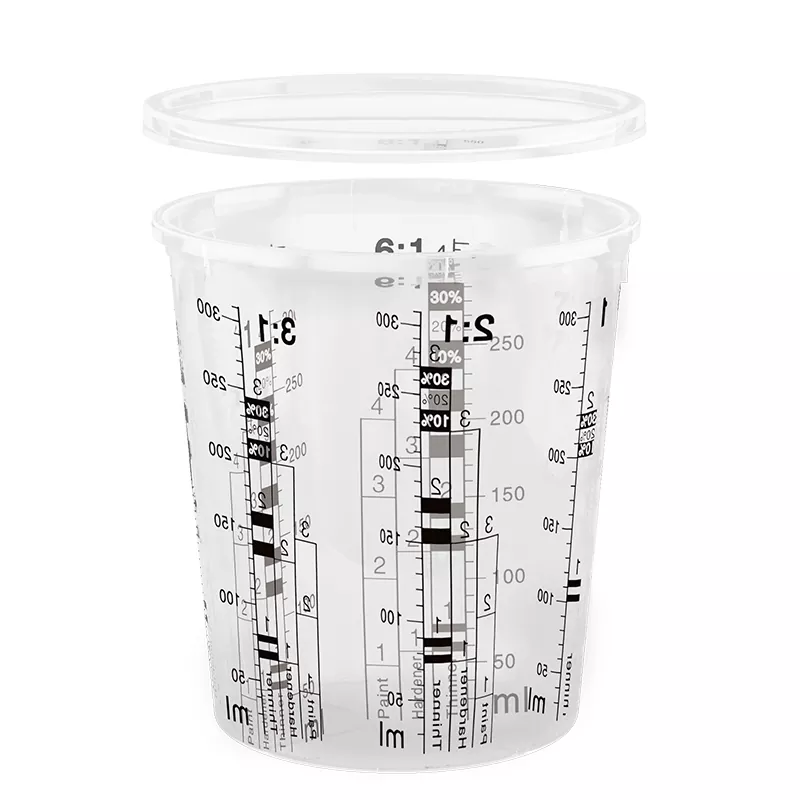
In professional coating work, a small measuring error can create a large finishing problem. Paint, hardener, thinner, primer, varnish, and other coating materials usually need to be mixed in a specific ratio. When that ratio is wrong, the result may look acceptable at first, but the problem often appears later. The coating may dry too slowly, lose gloss, show color variation, crack, peel, or fail to bond correctly.
For an auto body shop, that can mean rework. For an industrial coating line, it may mean delayed delivery. For a furniture finishing studio, it may mean inconsistent surface texture. For a distributor, it may mean customer complaints about a product that was never the real problem. The issue was simply poor mixing control.
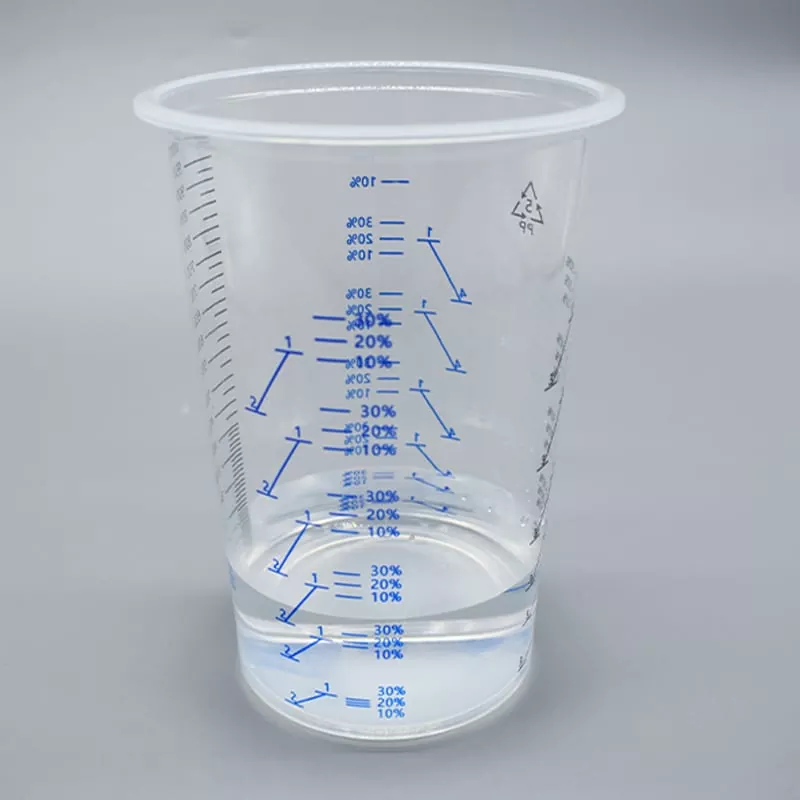
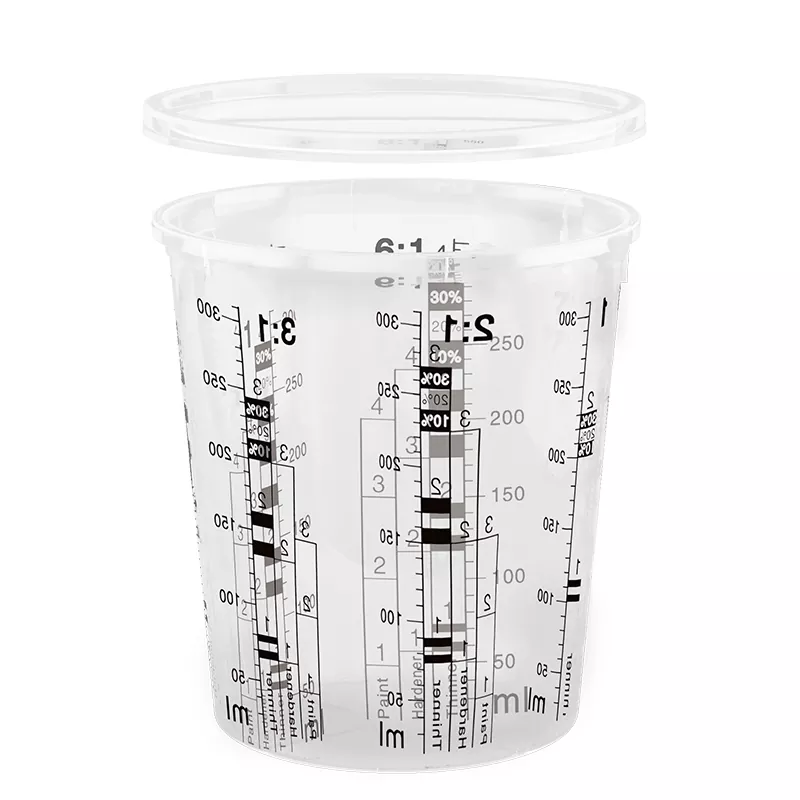
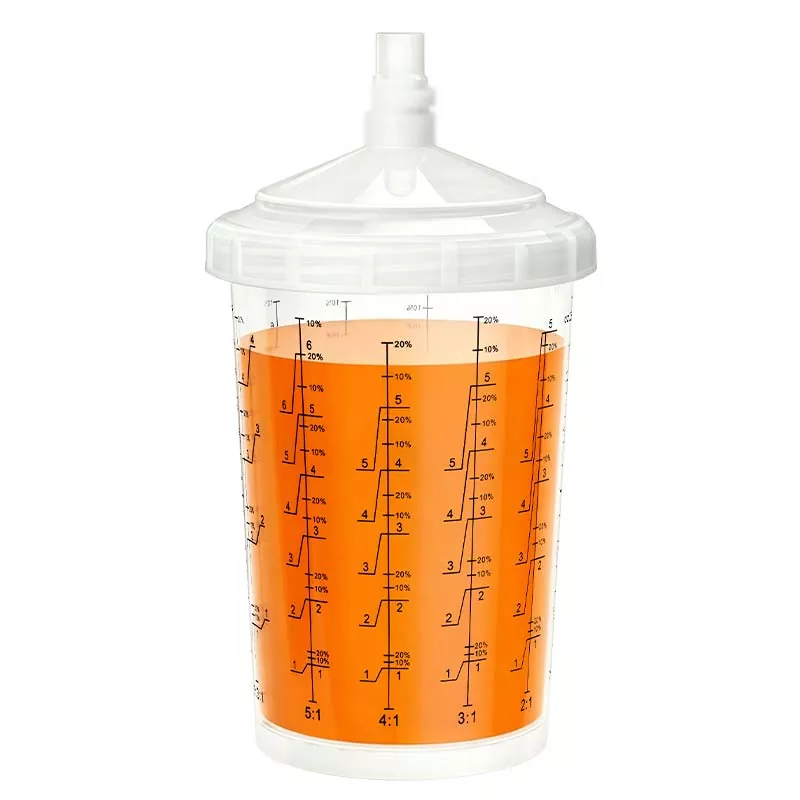
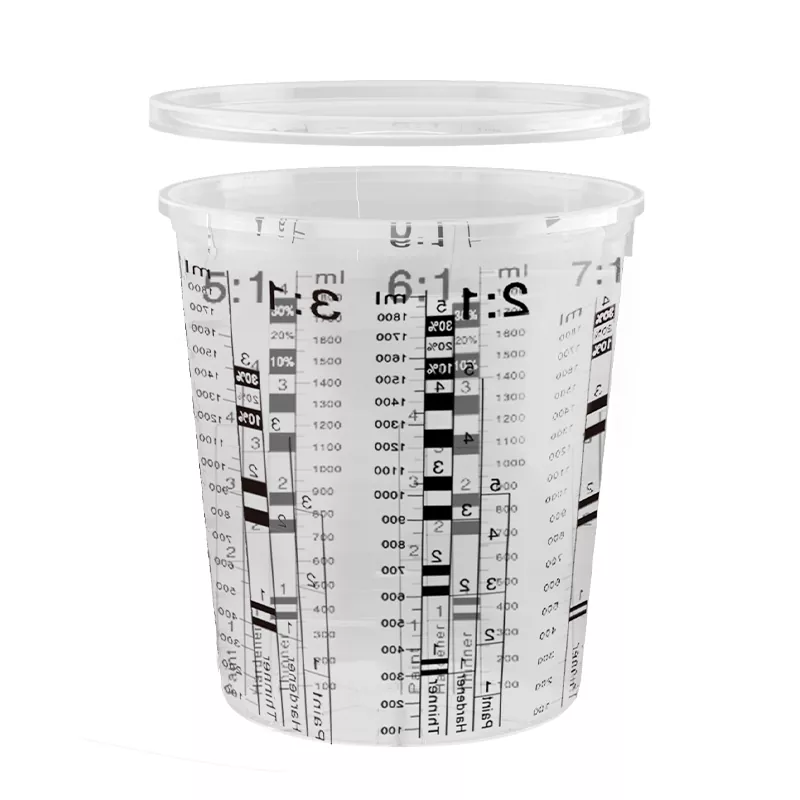
A good Paint Mixing Cup gives workers a clear measuring reference directly on the cup. Instead of guessing the amount of thinner or relying on a separate measuring tool, painters can pour each component according to the printed ratio lines. This simple tool helps reduce mistakes during one of the most important steps before spraying or brushing.
- Less material waste: Better ratio control reduces unusable mixed paint.
- Fewer color problems: Consistent mixing helps keep coating appearance stable.
- Faster preparation: Workers can measure, stir, cover, and move on quickly.
- Cleaner workstations: Cups with lids help reduce spills and short-term contamination.
- More predictable results: Repeatable mixing supports repeatable finishing quality.
What Makes a Paint Mixing Cup Different from an Ordinary Container?
An ordinary plastic container can hold liquid, but it is not designed for coating work. A professional Paint Mixing Cup is built around accuracy, convenience, material compatibility, and workshop efficiency. The difference becomes obvious when a painter needs to mix multiple coating systems in a busy environment.
The first major difference is the ratio scale. Professional cups are commonly printed with multiple mixing ratios, allowing users to prepare different formulas without changing tools. A painter working with 2:1 primer in the morning and 4:1 clear coat in the afternoon needs fast visual guidance. Clear scale markings help avoid hesitation and reduce training pressure for new staff.
The second difference is the material. Polypropylene, often shortened to PP, is widely used for paint mixing cups because it offers practical toughness, flexibility, and chemical resistance for many coating environments. A transparent or semi-transparent cup also allows workers to check the liquid level and mixing condition more easily.
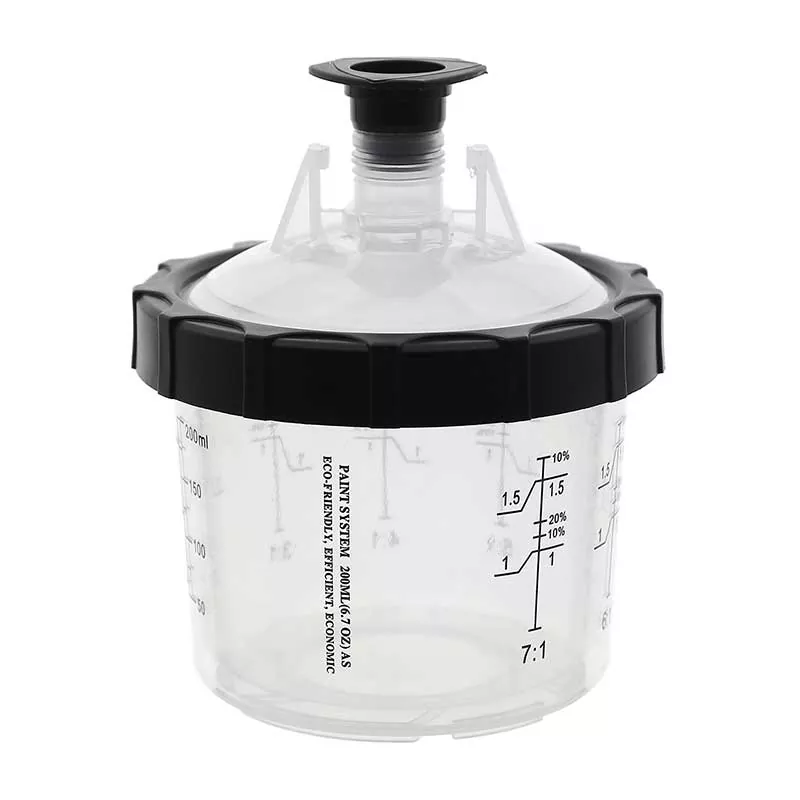
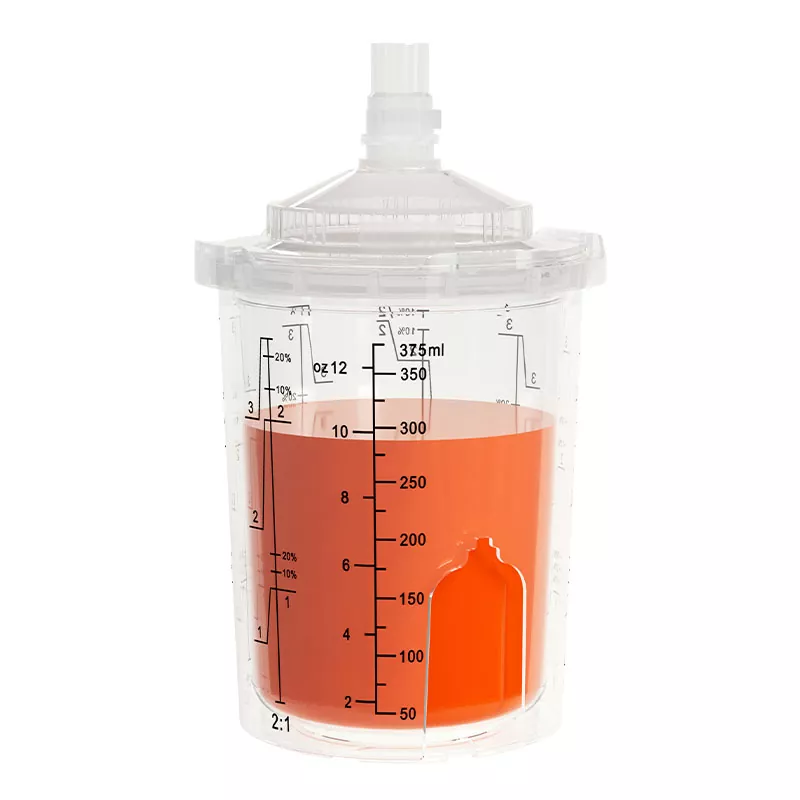
The third difference is compatibility with lids. A lid is not just a small accessory. It helps protect mixed paint from dust, reduces accidental spills, and supports short-term storage when workers need to pause between steps. For shops that handle several repair jobs at the same time, this is not a luxury detail. It is part of daily order and control.
The practical value of a Paint Mixing Cup is not only in the cup itself. It is in the way it reduces uncertainty during mixing, especially when time, labor, coating cost, and final appearance all matter.
How Should Buyers Choose the Right Paint Mixing Cup?
Buyers often compare price first, but price alone does not show whether a cup will perform well in a real workshop. A lower-cost cup may become expensive if the scale is hard to read, the cup cracks easily, the lid does not seal well, or the available sizes do not match common job requirements.
A better way is to evaluate the cup by use scenario. For automotive refinishing, the key concerns are ratio clarity, anti-spill handling, and compatibility with fast-paced work. For construction coating, large capacity and easy pouring matter more. For wood finishing, transparency and small-batch accuracy may be more important. For distributors, stable specifications and repeatable supply are just as important as product appearance.
| Buying Factor | Why It Matters | Practical Check |
|---|---|---|
| Clear ratio markings | Helps workers mix paint, hardener, and thinner accurately. | Check whether common ratios are easy to read from normal working distance. |
| PP material | Supports strength, flexibility, and practical resistance in coating use. | Ask whether the cup is suitable for the paint systems your customers use. |
| Capacity range | Different jobs require different batch sizes. | Choose small cups for repair work and larger cups for larger coating areas. |
| Lid option | Helps reduce spills, dust entry, and solvent evaporation during short-term storage. | Confirm whether cups and lids can be purchased together or separately. |
| Stacking and storage | Improves warehouse organization and workshop access. | Check packaging quantity, cup nesting, and ease of separation. |
| Supplier experience | Reduces risk for distributors and repeat buyers. | Look for product focus, stable categories, and responsive communication. |
Qingdao Aspaint Technology Co., Ltd. focuses on paint preparation products for coating users who need practical tools rather than complicated equipment. Its Paint Mixing Cup options are designed for measuring, stirring, and short-term paint storage, making them suitable for professional users who want simple tools that work reliably in daily operation.
Which Capacity Works Best for Different Painting Jobs?
Capacity selection is one of the most common pain points for buyers. A cup that is too small forces workers to mix twice, which increases the chance of inconsistent color or ratio. A cup that is too large may waste space, increase material residue, and feel inconvenient for small repairs. The best choice depends on the amount of coating required for the task.
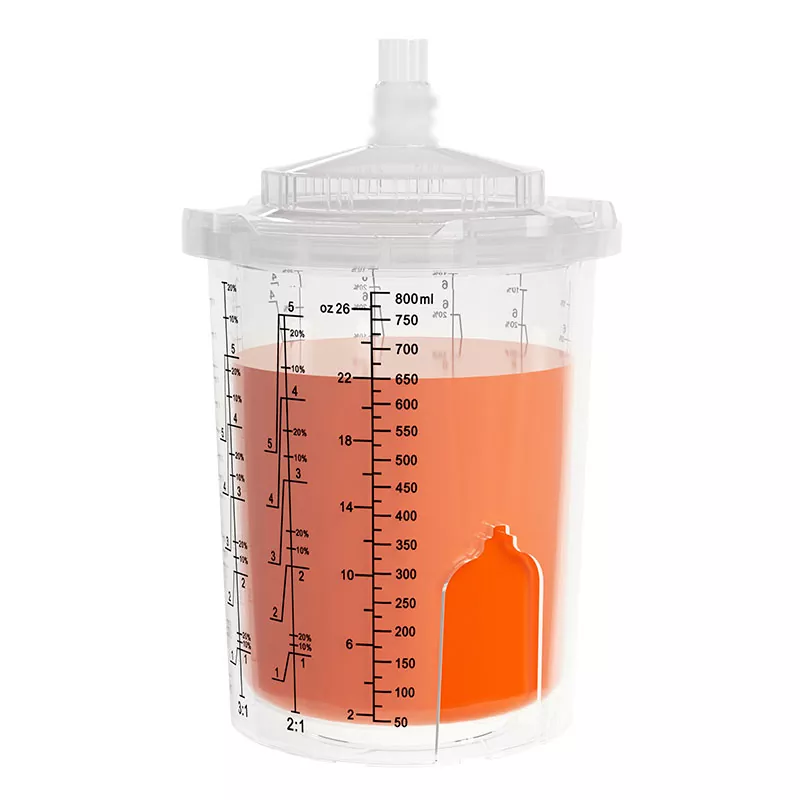
For small repair jobs, a compact cup is usually enough. For panel repair, motorcycle parts, small furniture pieces, or sample spraying, a smaller capacity gives better control and less waste. For medium repair work, a mid-size cup can provide a good balance between handling comfort and material volume. For larger surfaces, such as full vehicle panels, doors, machinery covers, construction parts, or broad wood surfaces, a larger cup can reduce the need for repeated mixing.
| Capacity Type | Suitable Work | Buyer Benefit |
|---|---|---|
| Small capacity | Spot repair, sample mixing, small parts, touch-up work. | Less waste and easier control for small batches. |
| Medium capacity | Automotive panel repair, furniture coating, regular workshop use. | Balanced size for frequent daily jobs. |
| Large capacity | Construction coating, larger panels, industrial parts, broad surface painting. | Fewer repeated mixes and better batch consistency. |
A supplier with multiple capacity choices gives buyers more flexibility. Instead of forcing every customer into one size, distributors can match the Paint Mixing Cup to the real working habits of their market. This is especially useful for buyers serving auto body shops, industrial coating contractors, furniture factories, and maintenance teams at the same time.
How Does a Better Cup Improve Daily Workshop Efficiency?
Workshop efficiency is not only about large machines or skilled painters. It is also shaped by small tools that workers use dozens of times a day. A poorly designed cup slows people down. They stop to check the scale, wipe spills, search for another container, clean reusable buckets, or remake a batch that was mixed incorrectly.
A well-designed Paint Mixing Cup keeps the process simple. Workers choose the right size, pour the material according to the ratio line, stir the mixture, cover it if needed, and move to the next step. The cup becomes part of a repeatable process. This is useful for both experienced painters and new staff because it turns a technical task into a clear visual routine.
- Choose the cup size according to the coating area and estimated material need.
- Read the ratio scale before pouring to avoid correcting mistakes later.
- Add each component according to the required paint system formula.
- Stir fully until the mixture becomes uniform and ready for use.
- Use the lid for short pauses, cleaner handling, and safer movement around the workstation.
- Dispose or organize properly according to the workshop’s coating waste procedure.
For procurement teams, this workflow benefit is important because users rarely judge a consumable by appearance alone. They judge it by whether it saves time when the workshop is busy. A cup that supports speed, accuracy, and cleanliness is easier to reorder because it becomes part of the painter’s habit.
What Details Should Procurement Teams Compare Before Ordering?
When buying Paint Mixing Cup products in bulk, procurement teams should look beyond a single photo. The cup may look simple, but its real value depends on details that affect daily use. A strong procurement decision should consider both product performance and supplier support.
| Question to Ask | Why the Answer Is Important |
|---|---|
| Are the ratio lines clear and practical? | Painters need fast reading during real work, not only in product photos. |
| Does the material suit coating environments? | Paint, thinner, hardener, and solvent contact require suitable material selection. |
| Are several sizes available? | A wider size range helps serve different customer groups and applications. |
| Can the lid be supplied with the cup? | Lids improve cleanliness, temporary storage, and user convenience. |
| Is the packaging suitable for wholesale handling? | Good packaging supports storage, shipping, and distributor inventory planning. |
| Can the supplier communicate clearly? | Fast response and clear specifications reduce ordering mistakes. |
These questions help buyers avoid choosing only by the lowest quotation. A professional consumable should support the user from the first pour to the final finish. If a cup saves a few cents but causes a painter to waste coating material, delay a job, or redo a surface, the real cost is much higher than the unit price.
Where Can Paint Mixing Cups Be Used?
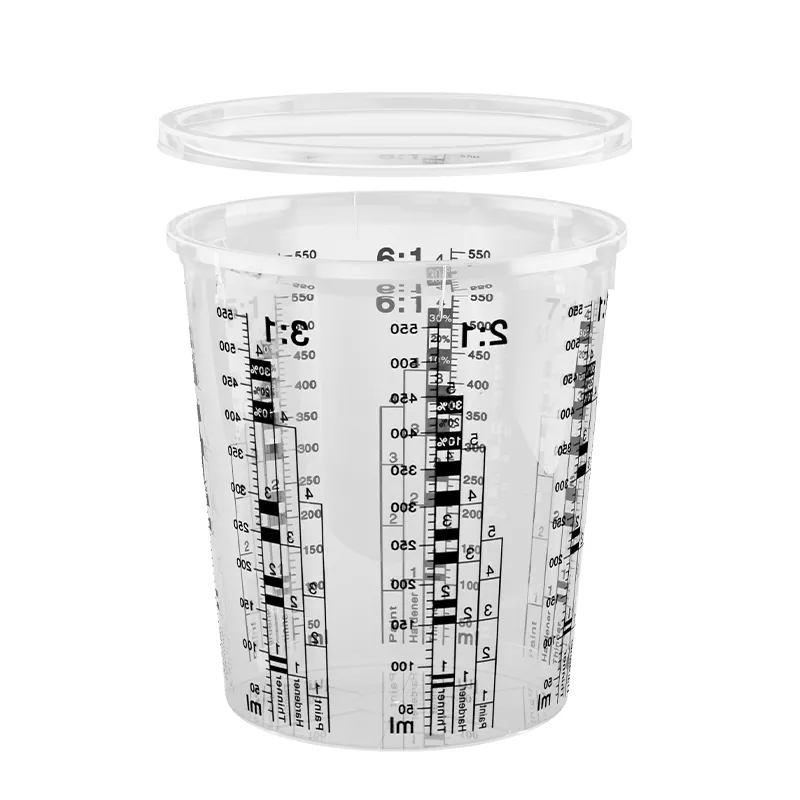
A Paint Mixing Cup is widely used because coating preparation is needed across many industries. Although automotive refinishing is one of the most common applications, the same tool can support other painting and finishing tasks where accurate liquid measurement matters.
- Automotive refinishing: Used for mixing basecoat, clear coat, primer, hardener, and thinner during repair and repainting work.
- Industrial coating: Useful for machinery parts, metal components, equipment covers, and protective coating preparation.
- Wood finishing: Helps furniture workshops and wood product studios control varnish, stain, and coating formulas.
- Construction painting: Larger cups can support coating preparation for bigger surface areas and maintenance projects.
- Training and sample work: Clear ratio lines make the cup helpful for teaching new workers and preparing small test batches.
For distributors, this broad application range can make the product easier to promote. Instead of selling only to one narrow user group, a distributor can position the cup as a practical consumable for coating preparation, repair work, surface finishing, and workshop organization.
FAQ
What is a Paint Mixing Cup mainly used for?
It is mainly used to measure and mix paint, hardener, thinner, primer, varnish, and other coating materials according to required ratios. It helps painters prepare a more consistent mixture before spraying, brushing, or coating.
Can a Paint Mixing Cup help reduce paint waste?
Yes. Clear scale markings help users prepare only the amount they need and reduce ratio mistakes. This can lower waste caused by over-mixing, incorrect formulas, or failed coating results.
Why is PP material commonly used for paint mixing cups?
PP is practical for many paint preparation environments because it offers useful toughness, flexibility, and resistance for common coating work. It also allows the cup to remain light and convenient for daily handling.
Should buyers choose cups with lids?
Cups with lids are useful when workers need short-term storage, cleaner handling, and reduced spill risk. A lid can also help protect mixed paint from dust or accidental contamination during a busy workflow.
How many sizes should a distributor prepare?
A distributor serving different users should consider several capacities. Small sizes suit repair and sample work, medium sizes suit regular workshop use, and large sizes suit industrial, construction, or bigger surface coating tasks.
Is the cheapest cup always the best choice?
Not usually. A cheaper cup may cost more in the long run if the scale is unclear, the material is weak, the lid does not fit well, or the size range does not match customer demand. Practical performance should be compared with price.
Can Qingdao Aspaint Technology Co., Ltd. support wholesale buyers?
Qingdao Aspaint Technology Co., Ltd. provides paint preparation products for professional coating users and buyers. For wholesale needs, buyers can discuss cup size, lid options, specifications, packaging, and supply details based on their market requirements.
How Can Buyers Start a Practical Inquiry?
A good inquiry should be specific. Instead of asking only for a general price, buyers can share the target cup capacity, expected quantity, lid requirement, application industry, destination market, and any packaging preference. This helps the supplier recommend a more suitable Paint Mixing Cup and provide clearer purchasing information.
If you are sourcing paint preparation consumables for automotive refinishing, industrial coating, furniture finishing, construction painting, or distribution channels, Qingdao Aspaint Technology Co., Ltd. can help you compare practical options and choose a cup that fits your daily workflow.
How Can You Get the Right Paint Mixing Cup Faster?
Tell us your required capacity, application, quantity, and lid preference, and our team will help you match a practical Paint Mixing Cup solution for your market. For samples, specifications, wholesale pricing, or customized purchasing support, please contact us and send your inquiry today.
Related News
- How Does the 200ML Disposable Paint Cup System 1.0 Transform Automotive and Industrial Spray Painting Efficiency?
- Why the 400ML Disposable Paint Cup System 1.0 Is a Game‑Changer for Auto Refinishing?
- Why Is the 125mic Filter Mesh Paper Paint Strainer the Smart Choice for Efficient Paint Preparation?
- How Can a 1.0 Series Air Spray Gun Aluminum Thread Adapter Improve Spray Performance and Equipment Compatibility
- Why Is the 2.0 Series Air Spray Gun Stainless Steel Thread Adapter Essential for Achieving Professional Spray Finishing Results
- Is the 400ML Disposable Paint Cup System 2.0 the Smartest Choice for Modern Automotive and Industrial Painting
Leave me a message